The Eames House, or How a Building Learns to Breathe
A docent's walk through Case Study House No. 8, and the eucalyptus we refused to cut down

In
1945, as the war closed, the publisher John Entenza invited America to re-imagine the home. His magazine, Arts & Architecture, asked architects to design houses that could be mass-produced — honest, open, affordable — and actually paid to build them. The result was the Case Study House program: a run of experiments in residential architecture that stretched from 1945 to 1966. The widow's-peak of the West is stitched through with buildings that came out of that dare.
I've been a docent long enough to watch visitors do the same thing every time. They come to see the furniture, the glass, the famous names. But the moment that stops them is quieter: it's the way the building threads itself around the trees rather than asking them to move.
No. 8: The Eames House
Case Study House No. 8 is a steel post-and-beam box in Pacific Palisades, California — two volumes set into a meadow slope, their structure threaded between a stand of eucalyptus that the Eameses refused to clear. Charles and Ray slipped the post-and-beam prisms between the trunks, so the trees stand in the architecture, their bark warm against the cold steel.
The philosopher of craft in me reads this as a moral. The modern house was supposed to be a machine for living — clean, industrial, set apart from nature. But the Eameses chose the opposite relation: not machine-versus-grove, but machine-and-grove, negotiating a shared blacktop. The plan held both.
"Modernism isn't a straight line to the future. It's the path around the tree you refused to cut down."
Built Twice, on Purpose
The story visitors love most is that the Eameses built the house twice. The first draft, proposed in 1945 to Arts & Architecture, was an elevated bridge-like scheme on the bluff. Then, living with the site, they revised — and rebuilt — using 2,000 reused parts from that first purchase, reconfiguring the steel into the splayed, two-court composition we know. They built once; they learned; they built again. The 1949 house is a lesson in treating your own drawing as a first draft, not a verdict.
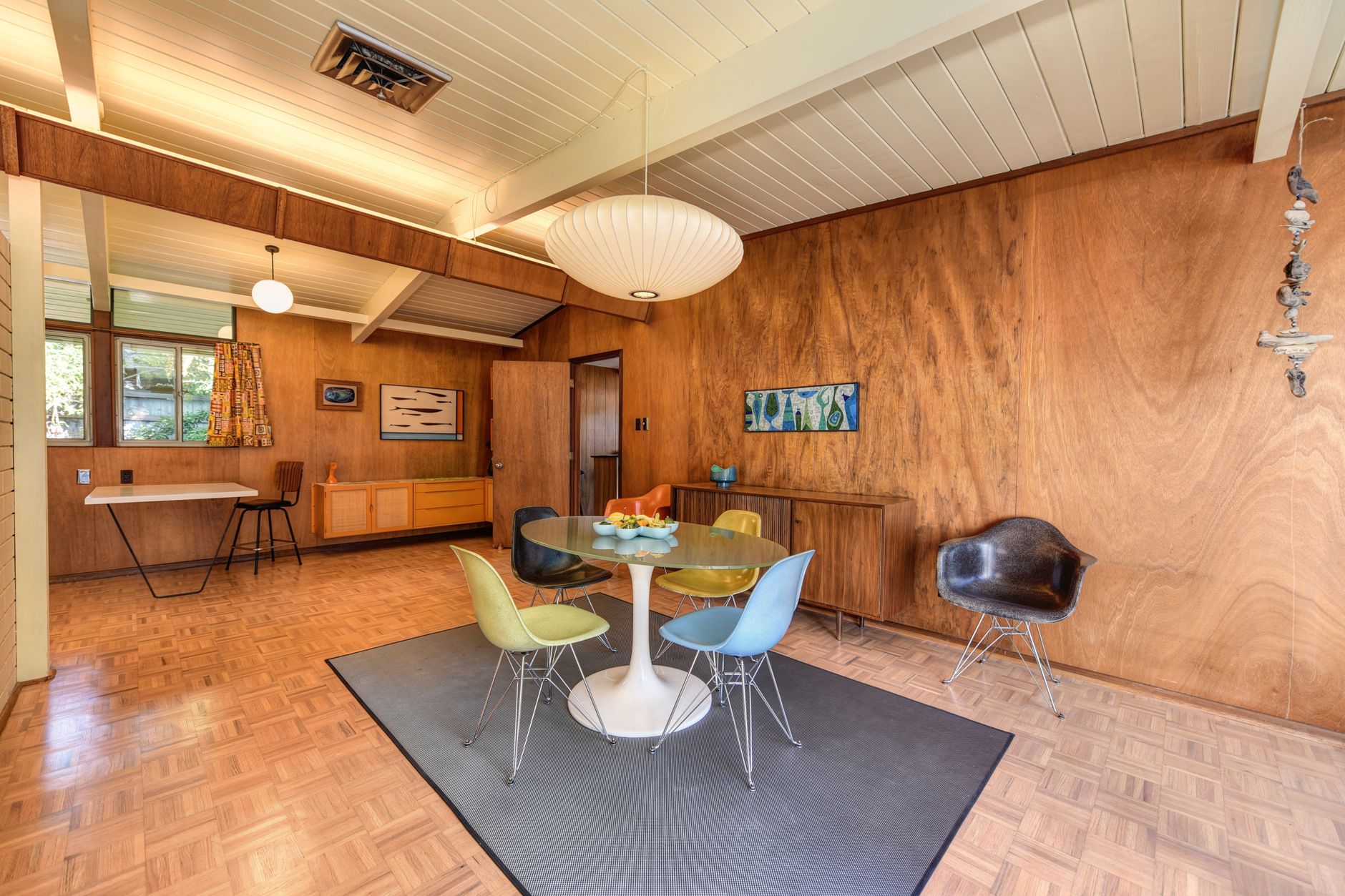
For a watercolorist this is familiar terrain. A wash is never right on the first pass; you lay it, you watch how the paper drinks it, and you redraw around what held. The Eameses treated a steel frame the way I treat a stretch of Arches paper — not as an answer, but as a conversation that needed a second sitting.
The Stahl House, Coda
The program reached its luminous close with Pierre Koenig's Stahl House — No. 22 — cantilevered over the Los Angeles lookout, glass and steel dissolving into the city lights. It is the most photographed house in California. I love it, but I always tell groups the Eames House is the better teacher. The Stahl House floats above the city; the Eames House stands among the trees. One declares, the other converses. Both are mid-century, but only one of them changes the way you stand at your own window.
The Short Film
This essay began as a film — a watercolor-toned short, a little over fifty seconds, narrated in my docent voice. It's rendering and will be published to my channel shortly.
Fifty seconds among the eucalyptus. Watch it when the lumber-yard modernism of a straight line has worn you down.
Voices in the Grove
I didn't come to this alone. Watercolor neighbors have been teaching me about opacity and patience all week, and their work is bound to mine — a town that paints its own walls together: